Marcus clicked to the next slide. Its title was only a few words: Religion and Public Order.

“One last point,” he said, his tone neither heavy nor light, “and probably the easiest one to avoid.”
“Beauville treats every faith equally — residents have complete freedom of private belief. But the zone’s public spaces are neutral.”
He paused.
“There are three principles we have to hold to, without exception.”
“One: religious activity is confined to private residences and registered places of worship. No form of religious ceremony or proselytizing is permitted in public spaces.
“Two: the total floor area of any basic place of worship is capped at 300 square meters, seating no more than 200. Construction requires a special permit from the zone’s governing commission beforehand.
“Three: no registered place of worship may be financed, under any name including religious donations, with funding from outside the zone.”
“This isn’t discrimination against any religion. It’s one of the core principles of the Singapore model — no single faith is allowed to claim the public square.”
“Faith, at its core, is a private relationship between an individual and the god they believe in. Its true value is in giving a person inner peace and strength in their darkest moments. In private, that force is pure, even noble. But once it’s mobilized as a group, it becomes social unrest and ethnic conflict. So when we limit the scale of places of worship, we’re using institutional design to let faith do what it does best — return it to the heart, and keep it away from politics.”
He looked around the room.
“The people of Beauville will hold every kind of belief. But no one’s sense of identity there will be built on faith. It will be built on the shared experience of building this city together.”
The moment Marcus finished speaking, the Australian Prime Minister nodded. “Fair point,” he said, his tone even but carrying real weight. “We’ve seen too many island governments torn apart by clan and religious lines. The last thing Canberra wants is one more mess in our backyard where people are pointing guns at each other in the name of faith.”
“But this is a little too radical, too idealistic.”
The British Prime Minister shook his head, his expression turning serious. “We cannot restrict freedom of belief on the very first page of the zone’s charter.”
The German Chancellor agreed. He rubbed his temples, his tone carrying the weight of European tradition. “The Prime Minister is right. Freedom of belief is indivisible. Trying to chop religion down to size with administrative force will only provoke violent backlash from underground churches. History has shown that the more a space suppresses belief, the more aggressive that belief tends to become.”
Marcus looked calmly at the two heads of state. “Prime Minister, Chancellor — the migrants coming to Beauville will come from different countries, different faiths, different sects. If we don’t establish the rules from day one, they’ll quickly start competing over whose place of worship is bigger, whose congregation is larger — and faith will drift away from what actually matters.”
He paused.
“What we’re limiting is scale, not belief itself. They can still pray. They can still find peace within their faith. We’re simply not allowing any force to ‘capitalize’ on that faith — to turn it into a tool for mobilization that leads to social unrest.”
“Singapore has run on this same rule since its founding. Not once has it seen religious rioting.”
He saw the Japanese Prime Minister nodding, glanced at the others’ serious faces, and said, slowly, deliberately:
“We are investing enormous sums to build a prosperous economy. Not a second Lebanon. Not a second Syria.”
The British Prime Minister and the German Chancellor exchanged a glance, something like a rueful smile passing between them. “Fine,” they said to Marcus. “You make a fair point too.” The Canadian Prime Minister looked thoughtful and said nothing. The Italian Prime Minister’s face was unreadable, as though she were still turning it over.
Marcus closed the slide on healthcare and education details. Rather than moving straight into implementation, he opened another slide, this one titled “The Institutional Paradox.”
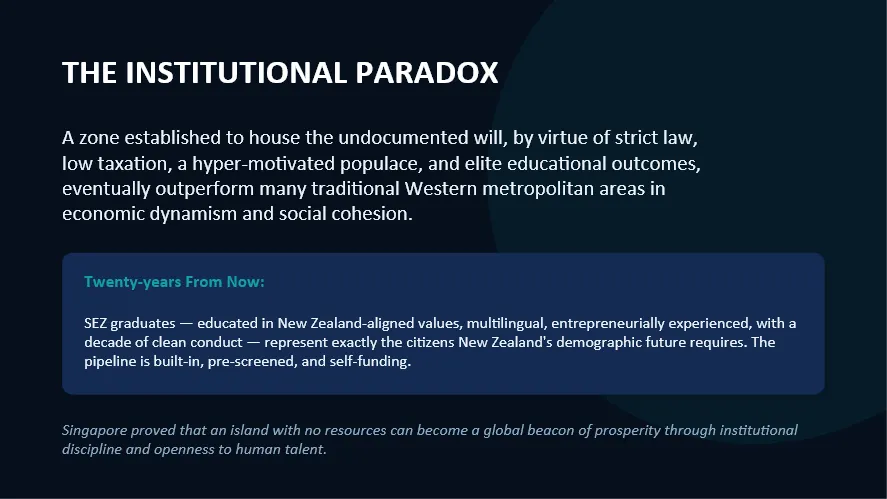
“Before we get into the technical details, we have to face a paradox — one that’s unavoidable, and frankly, one that may make some of you in this room uncomfortable.”
He pointed to the large text at the center of the screen:
“A zone originally built to house undocumented people — through strict rule of law, low taxation, an extraordinarily motivated population, and top-tier educational output — will, in the end, surpass many traditional Western metropolises in both economic vitality and social cohesion.”
“Every developed nation here today carries centuries of civilizational capital, world-class universities, the deepest reserves of capital. But you also carry an irreversible, heavy burden — the fiscal inertia of high welfare spending, the judicial inefficiency born of excessive political correctness, the social stagnation of an aging population, and a class divide that grows more entrenched by the year.”
“And Beauville is a blank page.” Marcus paused. “It has no electoral tug-of-war, no entrenched interest groups. From day one, it will run on the purest, most modern, most ideologically unadulterated strict rule of law and rational economics there is. The structural reforms your own nations can never push through, because of political resistance — on this island, they’ll run at maximum efficiency.”
He pointed to the dark blue block below: Twenty Years From Now.
“What happens twenty years from now? The zone’s graduates — raised on modern civic values, multilingual, forged by real entrepreneurial experience in an offshore, zero-tax market, and, more importantly, holding seven years of a clean record.”
The corner of Marcus’s mouth lifted slightly, a trace of pride in being the “perfect migrant sample.” “They are exactly the people every funding nation will need most, in the years to come. They are the perfect industrial workers, the perfect digital elite. And this talent pipeline is entirely built-in — pre-screened, and entirely self-financed. Your countries won’t need to spend a single dollar educating them. They will have completed their own evolution.”
At the very bottom of the slide, a line of italic text stood out sharply against the dark background:
Singapore proved it: an island with no natural resources can, through institutional discipline and openness to talent, become a global benchmark for prosperity.
“This is not a shelter, gentlemen.” Marcus straightened, his voice carrying through the marble-walled room. “This is an institutional incubator. Keep these people locked outside your border walls, and they are a bomb waiting to go off. But put them inside this machine, and twenty years from now, this zone — built by undocumented people — will be the next Singapore. That is the power of institutions.”
A dead silence fell over the room.
The prediction wasn’t just striking — it carried a kind of chill that ran down the spines of leaders of old empires. They couldn’t refute it. Because Singapore had already proven it once, in history.
The Italian Prime Minister, who had remained expressionless the entire time, stared fixedly at the words “surpass many traditional Western metropolises” on the screen for a long moment, then spoke, her voice low:
“This investment is starting to sound like something real.” She glanced at the Australian Prime Minister beside her. “We’ve already discussed setting up this zone on an island somewhere in the South Pacific. Has anyone given thought to how we actually get a nation to hand over an island like that?”
