
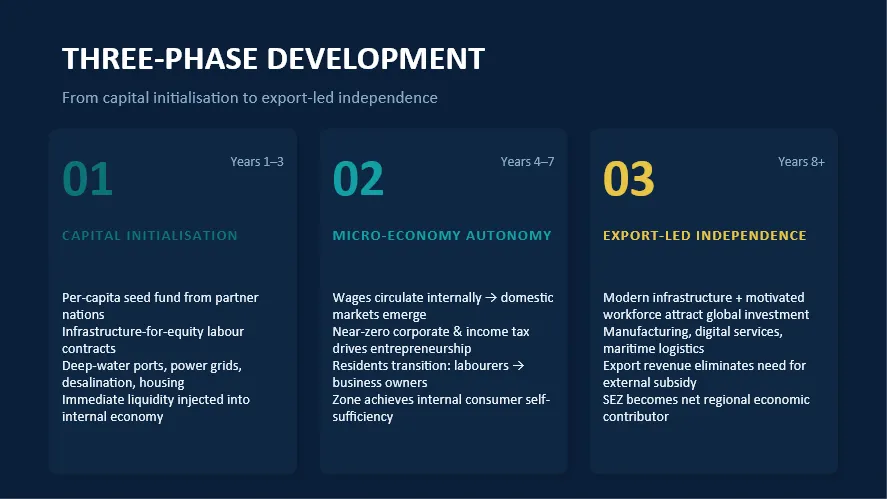
Marcus advanced to the next slide. On screen, the abstract concept took shape as a clear timeline:
“Three-Phase Development Path: From Capital Launch to Export-Driven Full Independence.”
“If governance is the skeleton, then economy is the blood.”
Marcus pointed to the first, dark green block.
Phase 01: Capital Launch and Infrastructure (Years 1–3)
“The first three years are the foundation period. Funding nations pay a launch fee based on the number of residents they send, plus an interest-free loan drawn from their migrant resettlement budgets. Combined with assistance funds from various other sources, this money will flow into a ‘Sovereign Seed Fund.’ We are not simply building aid projects — this is infrastructure-for-equity. Every brick of the deep-water port, the power grid, the desalination plant, the residential quarters — all of it becomes a core asset of the zone.
“More critically, labor contracts inject liquidity into the internal economy immediately. Migrants can secure work here after only basic training. They earn wages by building their own homeland, and in doing so, they exchange that labor for a future share of ownership. From day one, they are small shareholders in this land — not parasites on it.”
He watched the French President’s reaction; she was thoughtfully underlining something.
Marcus moved on, pointing to the middle, teal-colored block.
Phase 02: Micro-Economic Autonomy (Years 4–7)
“By year four, once the infrastructure is complete, wages will begin to circulate naturally within the zone. Retail, logistics, and services will spring up like mushrooms after rain. Because we’ve committed to near-zero corporate and personal income tax, the cost of starting a business here will be minimal. At this stage, residents’ identities shift — from pure ‘builders’ to ‘operators’ and ‘service providers.’ The zone will achieve basic self-sufficiency, forming a closed, self-sustaining micro-economy. External ‘transfusions’ will drop sharply.”
Finally, his hand rested on the gold lettering.
Phase 03: Export-Driven and Open to the World (Year 8 onward)
His voice rose slightly.
“This is the moment you’ve all been waiting for. Starting in year eight, the zone will possess modern infrastructure and a highly motivated, low-cost labor reserve. This will draw global manufacturing, digital services, tech outsourcing, and maritime logistics to set up here. Export revenue will fully replace external subsidies. The zone will formally shed the label of ‘burden’ and become a net economic contributor to the region. It will not only give back to its neighbors — it will become the most stable trading partner any of you have in the South Pacific.”
“Eight years.” Marcus turned and caught the American President’s eyes — now open. “In just eight years, we can turn a ‘border problem’ that bleeds money every single minute into a ‘blue-ocean asset’ that turns a profit every single year. We would no longer be paying people to take refugees off our hands — we’d be investing in the Pacific’s next gateway.”
The American President laid both hands flat on the table and leaned forward slightly — showing, for the first time, a flicker of genuine interest.
“I don’t much care what happens after eight years. What I want to know is — can this thing start sooner? Can we get the people we’re holding out of our hands faster?”
Someone in the room shifted quietly in their chair.
Marcus didn’t miss a beat.
“Yes. Once the site is confirmed, the first residents can be relocated within six months at the earliest. The island will need an initial labor force for basic construction anyway.”
The American President nodded, tilted himself sideways in his chair, his expression loosening a little.
“Good. Now, on construction — ” He paused, as though weighing his words carefully, though he clearly wasn’t weighing anything at all. “My son-in-law Gary has a lot of experience in this. His company handled plenty of major real estate projects. Infrastructure work would come naturally to him. You should let him take the big projects. And you might get funding from me even sooner.”
No one responded right away.
The Italian Prime Minister turned his upper body slightly toward the door, as if he wished he could simply get up and leave.
The British Prime Minister glanced at him with a look loaded with meaning.
The Japanese Prime Minister covered her mouth with one hand, a flicker of amusement in her eyes.
The Canadian Prime Minister looked up at the ceiling.
The President of the European Commission picked up her water glass, took a sip, and said evenly:
“All construction projects will go through international open tender. Companies from any funding nation are welcome to bid, selected on qualifications and price.”
The French president chimed in. “Yes — that’s how the project will operate.”
The Commission President paused, then added:
“Of course, qualified American companies are welcome to bid as well. Including your son-in-law’s.”
Marcus stood quietly, pressed his lips together, blinked once, and looked down to click to the next slide.

At that moment, the door opened a crack. An aide stepped in, moving quietly, and leaned down to whisper something into the American President’s ear.
The President’s face changed instantly. He pulled both hands back from the table, stood up, and straightened his suit.
“I got to go,” he said, his tone considerably more subdued than before. “Something more urgent has come up. You people continue without me — send the documents to my office when you’re done.”
He turned and walked toward the door, his pace noticeably quicker than when he’d entered.
The room exchanged startled goodbyes, watching him go.
The door closed.
A moment of silence.
Several people glanced down at their phones almost simultaneously.
Urgent briefings from their respective embassies in Washington. The content was largely the same: in several American cities, migrant demonstrations had spiraled out of control, escalating into armed clashes between opposing factions. The National Guard had been deployed. Fires were burning across several city blocks. Casualty figures were not yet clear.
No one read it aloud.
The French President turned his phone screen face-down on the table.
The German Chancellor set his phone down, took off his glasses, looked at them, and put them back on.
The Japanese Prime Minister stared at his phone, a look of shock crossing his face, one hand rising to cover his mouth.
The President of the European Commission glanced at the empty chair, then turned to Marcus, her voice even:
“Marcus. Let’s continue.”

Marcus was just about to click to the next slide when the French President raised a hand, as if he had something to say.