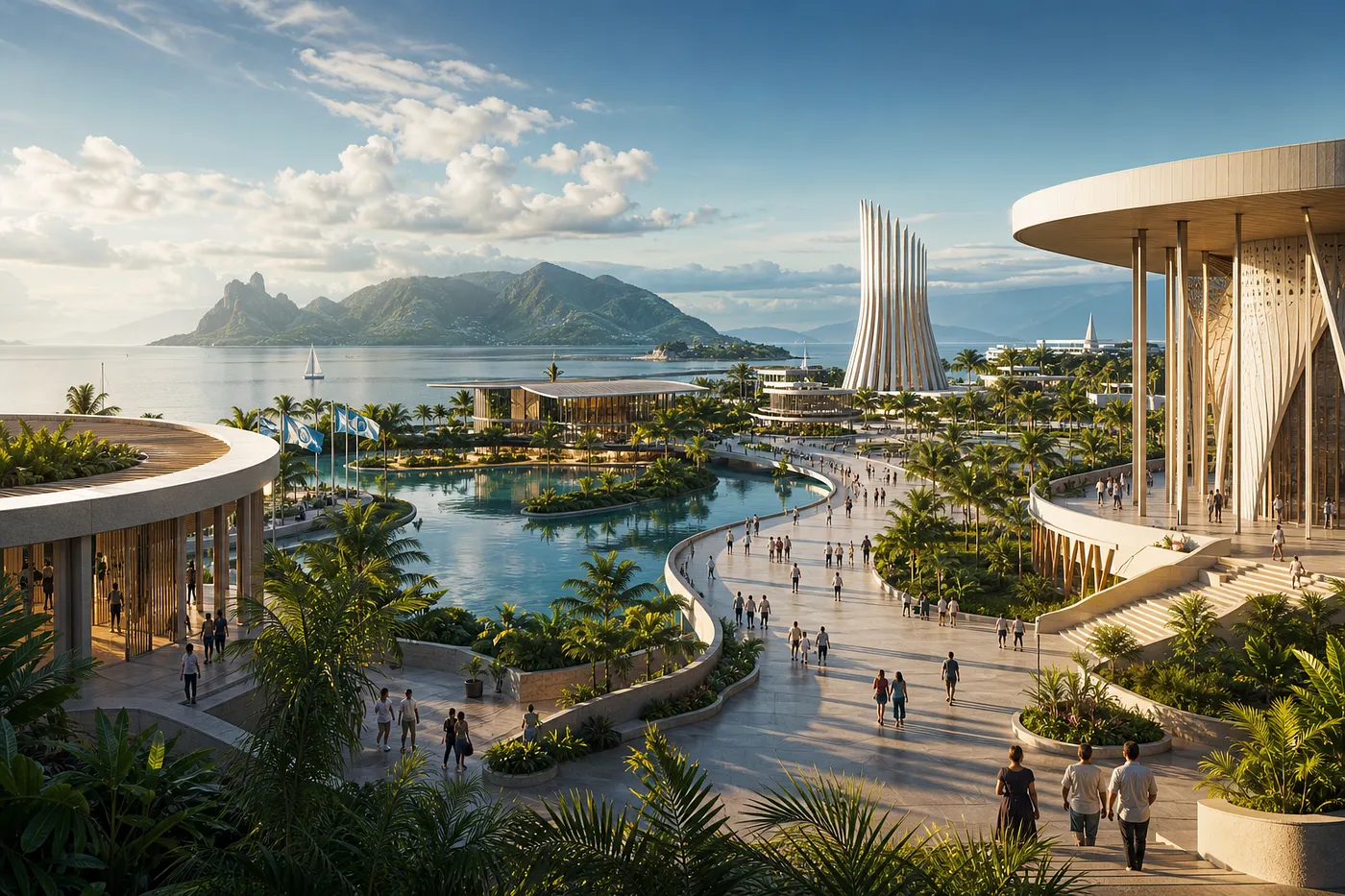
Marcus advanced to the next slide. The heading read,
Two Approaches, Both Failing

“Now, please allow me to continue. Over the past few decades, we have tried two approaches to the problem of undocumented migration. Neither has worked.
Marcus gestured toward the dark blue block on the left side of the screen — labeled The Welfare Dependency Trap.
“The first approach is the compassion we have tried, again and again, for thirty years. We treated migrants as passive recipients of aid — housing them, subsidizing them, at considerable fiscal cost. The intentions were good. But what were the results?”
Marcus studied the faces of the German and Canadian Chancellors. The latter’s hand moved absently around his coffee cup.
“The result is plain to see: this model strips migrants of their agency as creators. They are confined to settlements on the urban periphery, forming parallel societies cut off from the mainstream.
“When that long-term expenditure provokes strong resistance from taxpayers, the policy runs into a dead end. Scale it up, and it becomes fiscally unsustainable.
“This resentment has, in turn, fueled the rise of the far right across our countries. I imagine everyone in this room has felt that firsthand.”
He turned and pointed to the block of yellow text on the right side of the screen: The Forced Deportation Fallacy.
“The second approach is the opposite extreme. Mass deportation is not only a logistical nightmare — it is economic self-sabotage.”
He glanced, briefly, at the American President, his tone even. “Mass repatriation instantly severs the labor supply chain in agriculture, construction, and other critical sectors.
“Not to mention that billions in enforcement spending produce nothing in return — nothing but headline images of a humanitarian crisis that does lasting damage to the West’s moral standing.
“Both roads. We have walked them both. Both are dead ends.”
The atmosphere in the room shifted, subtly. He paused for a beat.
“So today, we are here to talk about a third road.”
The screen returned to the pulsing title: The Third Option.
“If supporting them bankrupts the treasury, and expelling them creates chaos, then there is only one logical conclusion left: let them create value for themselves, on land of their own.”
He paused again, his expression turning solemn, and looked around the room.
“We are not talking about charity. We are talking about an angel investment. We are proposing to take the money currently wasted on detention centers and welfare payments, and redirect it into infrastructure for an emerging economy.
“What we would give them is not a ration card, but a commercial code, a deep-water port, and a promise: legal status, earned through effort.
“On this island, there would be no refugees waiting passively to be processed. Only a first generation of builders.”
The German Chancellor, silent until now, finally spoke, his voice low. “If I may interrupt. Even if sovereignty and funding are resolved, there remains a central question. Who is responsible for law and order in this zone? If it becomes a vast, lawless territory with an advanced port, what we create will not be a new Singapore — it will be a pirate radio station. Or worse — a slum the size of a sovereign state.”
Marcus allowed himself a small smile, as though he had expected the question. He clicked to the next slide — a dense, multi-layered diagram of a governance structure.
“That is precisely what we are about to discuss: the Managed Autonomy Model. It will be co-endorsed by every nation at this table…”
Marcus clicked again. The next slide appeared, its title reading: Program Overview — An Offshore Autonomous Special Economic Zone.
Four clean blue blocks lined the screen, each topped with a simple icon.

“Here is your answer, Chancellor.” Marcus met the German Chancellor’s eyes and pointed to the first icon. “First: location.”
“As we’ve discussed, the core sites are remote islands in the South Pacific, leased long-term from their sovereign nations. I want to stress this: physical distance is itself an asset. Removing migrants from the chaos of their point of origin does more than sever the psychological hold of the old world — it makes the zone difficult to infiltrate by the same instability. Extremist religious conflict, gang networks — all of it stays physically sealed off, thousands of nautical miles away.”
He moved his hand to the second icon, a set of scales, and his voice dropped.
“As for your concern about a ‘slum’ or a ‘pirate station’ — the answer lies in the second pillar: governance.
“This is not an anarchic utopia. It is a self-governing special zone, modeled on Singapore, with strict rule of law. Those who follow the rules receive full protection. Those who break them are punished without leniency. Every person who sets foot on the island will be told these terms from day one. Only those willing to accept them may come. The rules themselves function as a filter — a form of positive self-selection. What remains, in the end, are only those who genuinely want order, and are willing to build their own future with their own hands.”

Marcus continued without pausing, pointing to the third icon, a construction crane.
“With order established, the next piece is a closed loop of economic self-sufficiency. This is what separates this project from any refugee camp.
“Before I describe the design, let me answer the most basic question: where does the money come from?
“No additional appropriations are required. Every funding nation already budgets for migrant resettlement every year — this money is already being spent. Our proposal simply converts a portion of it into an interest-free loan, injected into the zone’s founding fund.”
He paused.
“The difference is this: that money used to buy deportation flights, detention beds, legal fees, long-term welfare payments — spent, and then gone, leaving nothing behind. The same money, redirected, becomes a deep-water port, a power grid, schools, industrial parks. These are assets. They generate returns. They appreciate.
“This is not an additional burden. It is turning dead money into living money.”
Beyond that, the zone can also apply for grants from major funds, and from interested nations and corporations.
“For early construction capital, we will use an infrastructure-for-equity model — bringing in top-tier global engineering capital, hedged against the zone’s long-term labor contracts and future asset returns. To activate the market’s raw momentum, corporate and individual tax rates within the zone will sit near zero, using an absolute low-tax environment to draw labor-intensive and innovative industries offshore. Based on our actuarial modeling, we have designed a three-phase path to full economic independence within eight years. After that point, funding nations will not need to contribute another cent. The zone will run on its own.”
A faint rustle of papers moved through the room, along with murmured conversation. Marcus walked toward the final column on the screen — a graduation cap icon.
“Last, and perhaps most valuable to the Western nations in this room right now — the talent pipeline.
“The first generation will settle here and work. The second generation will grow up within a curriculum built on Western values — an education fully compatible with each of your home countries. We have set one hard threshold: seven years of good standing. Any resident who lives and works here for seven years, with no criminal record and no serious violations, will receive a globally recognized work permit.
“By then, they are no longer ‘undocumented migrants’ or ‘refugees.’ They are a screened, highly productive workforce, deeply aligned with the rule of law — free to flow legally into your countries. Your factories, your outsourced technology centers, your aging populations — all of it will receive the cleanest, safest possible supplement.”
“Site isolation. Singapore-style governance. A zero-tax economy. A seven-year pipeline of proven talent. That is the complete loop of Project Beauville.”

Marcus advanced to the next slide. On screen, the abstract concept took shape as a clear timeline: Three-Phase Development Path: From Capital Launch to Export-Driven Full Independence.